BeYourEyes NGO Volunteer Experience: Newcomer Training for Guide Runners – Accessibility Awareness Workshop

This reflection essay I wrote is about the experience that inspired me to become one of the founders of Beyoureyes x SHSID Club. Things that me and our club members have accomplished since Aug.2021 include:
• Provided weekly trainings and assistance visually impaired people in doing
physical exercises
• Organized & recruited 23 students for the NGO group 'Beyoureyes'.
• Ran with over 10+ visually impaired people
Personal Reflection from my first training:
When I first showed up, I was a little lost—still trying to find my footing after the group photo—before stepping into the training session. There were nine of us newcomers and two trainers. Right away, it was clear this wasn’t going to be the usual “I talk, you take notes” type of training. We stood in a circle, which immediately broke down barriers. No one felt above or below anyone else—trainers and trainees alike. From that moment on, we weren’t just individuals. We were a team.
For the icebreaker, we put on blindfolds and had to identify the objects in our hands by touch. It turned out we were each holding random English letters, and the challenge was to line up in the right order to spell v-i-c-t-o-r-y and snap a group photo. Once my vision was gone, I realized how much I had to rely on language. Judging direction and distance just from voices was unnerving. And when some questions or calls didn’t get a reply, it felt frustrating. That’s when it clicked: for people with visual impairments, timely verbal feedback isn’t just helpful—it’s absolutely necessary. When we finally pulled it off, the circle felt tighter, and people opened up more easily.
The point of this workshop was to build awareness about accessibility, and I have to say—it worked. Through hands-on practice, by watching others, and with trainer Chen Xiaobin’s guidance on how to support visually impaired people in everyday situations, I found myself learning and reflecting constantly. Beyond the practical skills, two things stood out: language and mindset.
Language. The first thing to do when offering help is to gently make contact—like a light tap on the arm—so the person knows you’re speaking to them. The second is to ask clearly if they need help, and in what way. If you can also keep your words short and clear, even better.
Mindset. I think there are two truths everyone should keep in mind:
1. Nobody wants to be pitied.
2. Don’t fall into a “rescuer” mentality.
Self-respect matters to everyone. Trainer Chen gave an example: at a subway station, some visually impaired people might need help gauging the height of a seat before sitting down, but others don’t and may even feel embarrassed if offered. He joked, “We don’t need someone to peel bananas for us either.” Funny as it sounded, it pointed to a common misconception—that people with visual impairments (or disabilities in general) can’t take care of themselves. It’s simply not true. And those assumptions, even when well-intentioned, can quietly chip away at someone’s dignity. Another example: speaking in an overly sympathetic, almost pitying tone. Often, that “kindness” is more about making the speaker feel good than about truly respecting the other person. At the end of the day, what really matters is empathy and treating people as equals.
Then came the highlight: guide running practice. Since we were all new, we paired up and took turns as both the guide runner and the visually impaired runner. I was matched with someone I’d never met.
Running blindfolded was an entirely new experience. The darkness ahead, not knowing what was around me—it made me uneasy. Maybe a family walking close would narrow the path. Maybe a low stone block would appear out of nowhere. My guide and I were connected by just a short tether. I held it tightly, worried that if they stumbled, we might both go down. My guide held it a bit more loosely. With no cane, no extra support—just the two of us—we faced stairs and steep slopes. The only choice I had was to put complete trust in my guide. That sounds simple, but it took real courage. I still caught myself trying to sneak peeks under the edge of the blindfold, even if it was only twenty centimeters of vision. For people with visual impairments, though, handing over that trust again and again is a way of life. That, for me, was the most powerful lesson of the day.
As the session wrapped up, we returned to the circle where we’d begun. A small circle in Shanghai, but one that carried a kind of energy much bigger than its size. Almost like an eye. Maybe that’s what it truly means—to be someone else’s eyes.
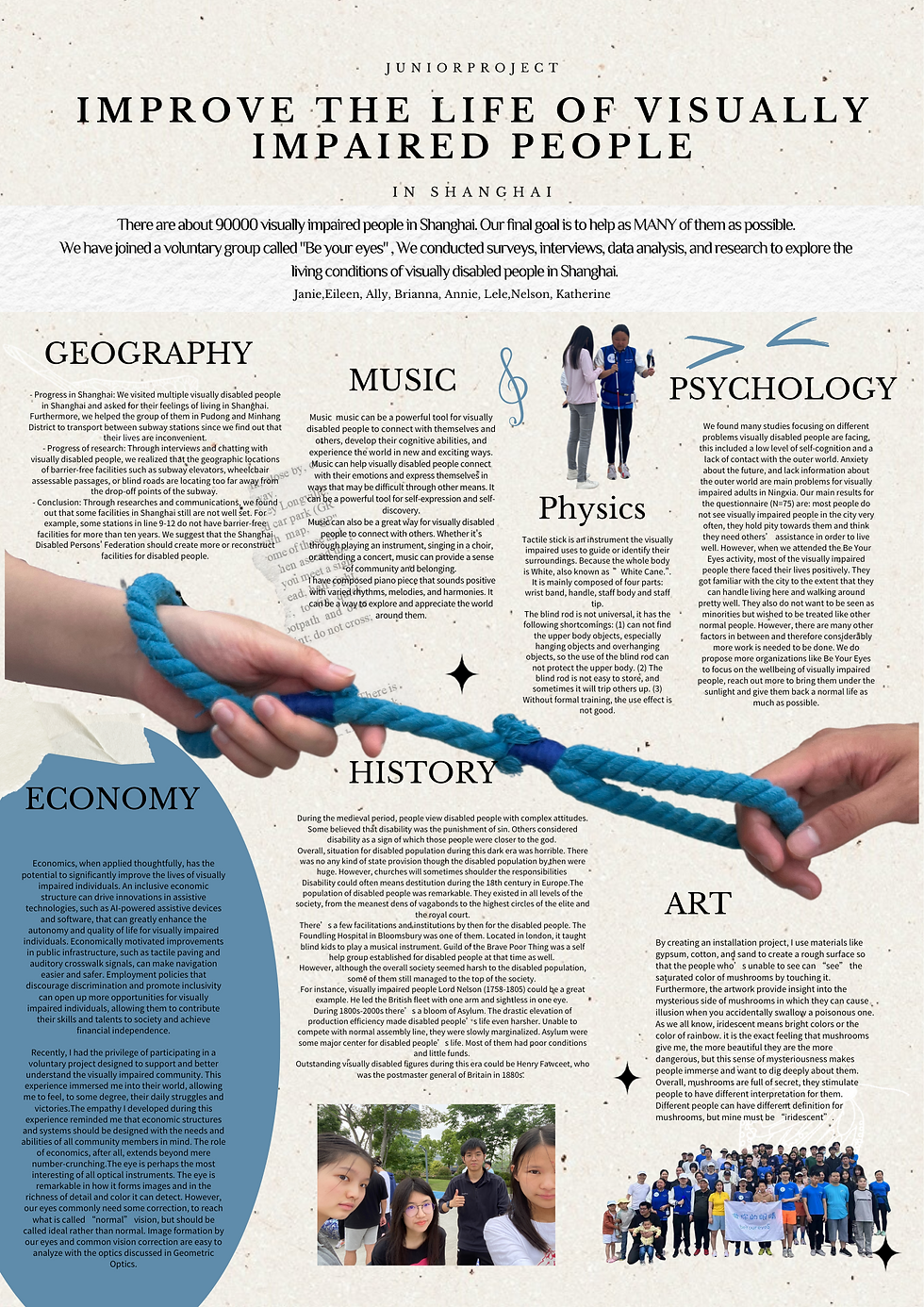
Junior Project:
This was the high school junior project we did surrounding on how to improve the quality of life of visually impaired people through utilizing the knowledges of different subject we learned in school:


Comments